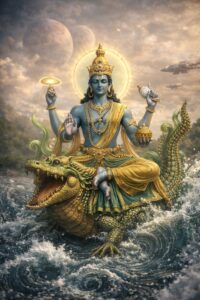
 Vedic thought places Varuṇa among the most profound and morally charged deities of the Ṛgveda—guardian of cosmic order, lord of the celestial waters, and witness to truth. When this ancient figure is viewed through the lens of Ratna‑śāstra, the classical Indian science of gems, a subtle but meaningful relationship emerges between Varuṇa cosmology and the symbolic, ritual, and elemental dimensions of gemstones. This essay explores that intersection: how Varuṇa Vedic identity, his elemental domain, and his moral authority inform the metaphysics of ratna in the broader Indic tradition.
Varuṇa in the Vedic Imagination
Varuṇa is one of the oldest and most majestic deities of the Ṛgveda. He is:
- Ruler of ṛta, the cosmic order that governs both nature and morality
- Lord of the celestial ocean, the unseen waters that surround and permeate the universe
- Guardian of truth, whose “thousand eyes” observe all actions
- Binder and releaser, who punishes falsehood yet grants forgiveness to the penitent
In hymns such as Ṛgveda 1.25 and 7.86, Varuṇa appears as a deity of immense moral gravity—one who binds the sinner with pāśa (noose) but also liberates through compassion. His waters are purifying, his gaze is penetrating, and his authority is cosmic rather than merely atmospheric.
Varuṇa domain is not the physical ocean alone; it is the cosmic waters (āpah)—the primordial matrix from which creation arises. These waters are luminous, subtle, and life‑bearing.
Ratna‑śāstra: The Science of Gems
Ratna‑śāstra, as preserved in texts like the Garuḍa‑Purāṇa, Agni‑Purāṇa, and Bṛhat‑Saṁhitā, treats gemstones as:
- Condensed cosmic energies
- Vibratory bodies linked to grahas (planets)
- Substances with elemental signatures
- Objects of ritual purity and auspiciousness
Each gem is associated with a graha, a color, a deity, and a specific tattva (elemental principle). Gems are not inert minerals; they are repositories of cosmic light (tejas) crystallized in the earth.
Varuṇa Elemental Domain and the Gemological Waters
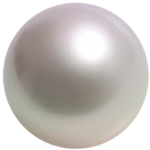
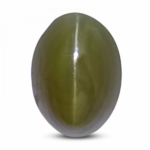
Pearl | Cats Eye
Varuṇa primary tattva is āpah (water)—not merely physical water but the subtle, life‑bearing, purifying principle. In Ratna‑śāstra, several gems are explicitly linked to the water element:
- Muktā (Pearl) — born of water, lunar, cooling, sattvic
- Vaidūrya (Cat’s Eye) — associated with fluidity and serpentine energies
- Nīla (Blue Sapphire) — deep blue like the cosmic ocean
- Puṣyarāga (Yellow Sapphire) — often described as having the clarity of pure water
Among these, pearl is the most directly aquatic. Classical texts describe it as:
शुक्ला मृदुला सुभगा मुक्ताफला शुभप्रदा
White, soft, lustrous pearl brings auspiciousness.
Pearl is the only major gem literally born from living waters, and thus it resonates most strongly with Varuṇa domain.
Varuṇa and the Moral Dimension of Gems
Varuṇa most distinctive Vedic attribute is his moral authority. He is the deity who:
- Upholds truth
- Punishes falsehood
- Purifies the inner being
- Restores cosmic harmony
Ratna‑śāstra, though primarily concerned with planetary energies, also emphasizes moral purity in the use of gems. A gem must be:
- Untainted
- Unblemished
- Ethically obtained
- Ritually purified
The Garuḍa‑Purāṇa repeatedly warns that flawed or impure gems bring misfortune. This insistence on purity echoes Varuṇa role as the purifier of both waters and moral life. Thus, Varuṇa ethos subtly permeates the ethical framework of Ratna‑śāstra: purity of substance mirrors purity of conduct.
Varuṇa and the Lunar Gem: Pearl
Although Varuṇa is not directly assigned a ratna in the Navaratna system (which is graha‑based), his closest symbolic gem is muktā (pearl):
- Both are associated with water
- Both signify purity and clarity
- Both have a cooling, calming, sattvic nature
- Both are linked to forgiveness and emotional balance
In later Purāṇic and Tantric traditions, Varuṇa is sometimes invoked in rituals involving pearls, conch shells, and other aquatic substances. Pearl, being the “gem of the waters,” becomes a natural emblem of Varuṇa domain.
Varuṇa: Cosmic Waters and Gem Formation
A deeper metaphysical connection emerges when we consider the ancient Indian view of gem formation. Texts describe gems as:
- Crystallizations of cosmic waters
- Solidified forms of light within fluidity
- Earth’s way of condensing celestial essences
This mirrors Varuṇa cosmology, where the universe itself arises from the luminous waters of creation. Thus, in a symbolic sense, all gems are children of Varuṇa waters, even if their planetary rulership varies.
Varuṇa as the Hidden Patron of Gemological Purity
Varuṇa does not appear in Ratna‑śāstra as a direct patron of any specific gem, yet his presence is unmistakable in the underlying metaphysics:
- The water element that gives birth to pearls
- The moral purity required in gem selection
- The cosmic waters from which all crystalline forms ultimately arise
- The ethical dimension of Ratna‑śāstra, echoing Varuṇa guardianship of ṛta
In this sense, Varuṇa stands as a silent but foundational deity in the world of gems—guardian of purity, witness to truth, and lord of the waters from which both life and luminosity emerge.