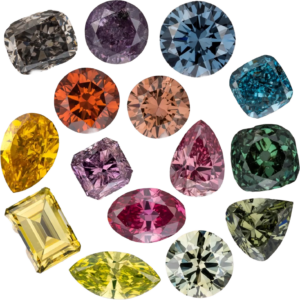
 Notable: White Diamond, Yellow Diamond, Pink Diamond, Blue Diamond, Black Diamond and Red Diamond
The diamond—composed of pure carbon and ranking Mohs 10, the hardest natural substance on Earth—has long been celebrated for its unmatched brilliance and fire. Its durability and radiance have made it a universal emblem of love, resilience, and timeless devotion.
Although the classic image of a diamond is crystal‑clear and colorless, these gems also appear in a spectacular array of fancy colors, from vivid canary yellow to soft romantic pinks and rare deep blues. These hues arise from trace elements or subtle structural variations formed deep within the Earth.
| Category | What it means | Typical cause | Rarity / value |
|---|---|---|---|
| D–F (Colorless) | No perceptible body color face‑up | Very low trace impurities | Most desirable in white diamonds; high value. |
| G–J (Near colorless) | Slight warmth visible to trained graders | Small amounts of nitrogen or structural tint | Common in jewelry; good balance of look vs price. |
| K–M (Faint) | Noticeable light yellow/brown | Nitrogen impurities or body tint | Lower value than near‑colorless when compared on equal clarity/cut. |
| N–R (Very light) | Clear warm tint | Higher levels of the same impurities | Less expensive; sometimes used for larger sizes where color is less visible. |
| S–Z (Light) | Obvious yellow/brown face‑up | Stronger impurity presence | Lower value for white diamonds; may be less desirable. |
| Fancy color (any hue beyond Z) | Distinct color such as pink, blue, green, red, orange, yellow, brown, black, gray, white | Specific impurities or structural causes (e.g., boron → blue; radiation/structural defects → green/gray; nitrogen aggregation → yellow/brown). | Rarity increases value—pink, blue, green, and red are especially rare and valuable. |
How color arises
Trace impurities: Elements like nitrogen and boron substitute into the carbon lattice and produce yellow/blue hues respectively. Structural defects / radiation: Lattice defects or exposure to natural radiation can produce green, gray, or brown tones. Aggregation state of impurities and how light interacts with the crystal determine whether a diamond falls on the D–Z scale or is classified as a fancy color.