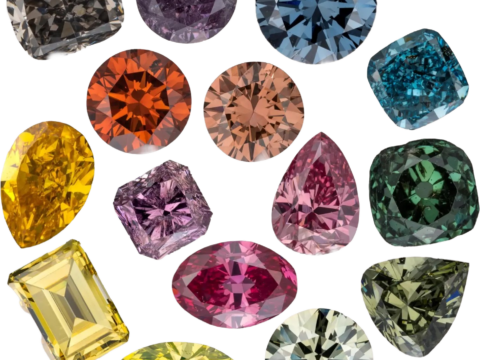
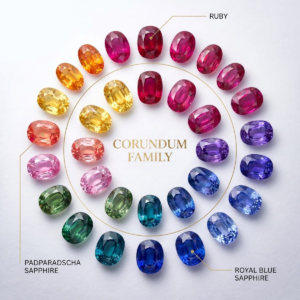
 Pure corundum is naturally colorless, but trace impurities introduce virtually every color of the rainbow into its crystal structure. Red corundum is famously known as ruby, while all other colors are collectively referred to as sapphires or “fancy sapphires”
The corundum mineral family, composed of crystallized aluminum oxide (Al2O3), is widely regarded as the “King of Colored Gems.” With a hardness of 9 on the Mohs scale (just a step behind the diamond at 10), corundum is surpassed only by diamond, making it exceptionally durable and well‑suited for everyday jewelry applications. Its physical robustness, combined with its optical versatility, has contributed to its prominence in both historical and contemporary gemology.
Ruby
Ruby refers specifically to the red variety of corundum. The term derives from the Latin rubeus, meaning “red.” The most esteemed rubies exhibit a saturated, vivid hue commonly described as “pigeon’s blood” red, characterized by a deep crimson body color with high fluorescence. Historically, rubies have held significant cultural and symbolic value, frequently associated with vitality, protection, and prosperity. Their coloration arises primarily from trace amounts of chromium, which substitute for aluminum within the crystal lattice and impart the characteristic red hue, as documented by the Gemological Institute of America (GIA).
Sapphire
All non‑red varieties of corundum are classified as sapphires, with blue sapphire being the most recognized. However, sapphires occur in a broad chromatic spectrum, including pink, yellow, green, violet, and the highly prized padparadscha, a rare blend of pink and orange reminiscent of a lotus blossom. The most valued blue sapphires display a soft, velvety cornflower blue coloration. According to GIA research, sapphire coloration results from trace elements such as iron and titanium, which interact within the crystal structure to produce blue tones, while varying combinations of impurities generate the full range of fancy sapphire colors.
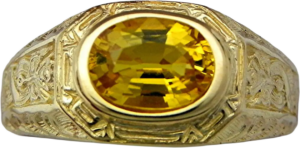 The yellow coloration of the grand ‘Yellow Sapphire’ is driven by a few distinct mechanisms:
- Iron (Fe³⁺): The primary chromophore. As the concentration of iron increases, the stone’s color deepens from pale yellow to a rich, golden, or orangish-yellow.
- Trapped Holes (\(h\bullet-Fe^{3+}\)): In some low-iron sapphires (notably those from Sri Lanka), the yellow hue is caused by a trapped hole paired with an iron impurity.
- Irradiation: Some yellow sapphires get their color naturally from low-level radioactive exposure within the Earth, though lab-induced irradiation can also be used.
- Heat Treatment: Many sapphires on the market are heat-treated to induce or intensify the yellow hue, which triggers the formation of the color-producing trapped hole paired with iron
Color Origins in Corundum
The diversity of color within the corundum family is fundamentally linked to trace-element chemistry and lattice defects.
- Chromium → red (ruby)
- Iron and titanium → blue (sapphire)
- Iron alone → yellow to greenish hues
- Mixed trace elements → pink, purple, and padparadscha tones
These substitutions alter the absorption and transmission of light within the crystal, giving rise to the remarkable chromatic diversity that defines corundum as one of the most important colored gemstone families in mineralogy.
Mantra Bhava Graha
The prominent and colorful spectrum of corundum are –
- Sun -Red (Ruby): Colored by the trace element chromium. High concentrations produce the highly prized “pigeon’s blood” red.
- Moon -Orange & Padparadscha: Orange corundum gets its color from iron and chromium. The highly prized pinkish-orange variety is called padparadscha.
- Mars -Pink (Sapphire): Also caused by chromium, but in much lower concentrations than a ruby. They sit on the fine line separating pink sapphires from rubies.
- Mercury -Green (Sapphire): Caused by iron or a mixture of blue and yellow chromophores (titanium and iron). Shades span from olive to vibrant emerald green.
- Jupiter -Yellow (Sapphire): Occurs due to iron impurities or trapped color centers. Shades range from pale lemon to deep golden-yellow.
- Venus -Colorless (White Sapphire): Pure, unadulterated aluminum oxide with no trace elements, resulting in complete transparency
- Saturn -Blue (Sapphire): Colored by a combination of iron and titanium. These range from light sky blue to deep royal blue.
- Rahu -Purple / Violet (Sapphire): The result of varying mixtures of iron, titanium, and chromium. Colors span from light lavender to deep violet.